
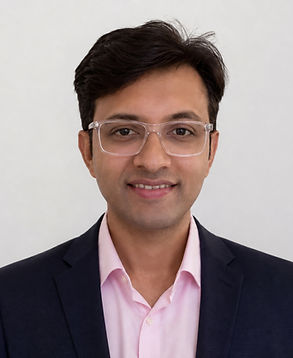
Dr. Purv Purohit
From Waste to Energy: Advanced Filtration Materials for Cleaner, Circular Energy Recovery
Sales Director
Industrial Filtration, Alkegen, Germany
Speaker Bio
Dr. Purv Purohit is an international business growth leader and expert in industrial filtration and material science. He currently serves as the Sales Director – Industrial Filtration at Alkegen His areas of expertise include high-temperature hot gas filtration, polymer science, emission control architectures, and sustainable process engineering. He has led major projects, including scaling regional business portfolios from $300k to over $10M across diverse international markets and setting up advanced analytical testing laboratories to support global technical sales.
He has regularly presented his technical findings at major industry platforms, including showcasing his research on Hot Gas Filtration Performance in Extreme Environments at FILTECH in Cologne. He has published several scientific research papers on nanocomposites and material properties in prominent international journals. He obtained his Ph.D. (Dr.-Ing.) in Polymer Science while working as a Doctoral Candidate at the BAM Federal Institute for Materials Research and Testing in Germany. He is deeply passionate about establishing global commercial strategies, driving sustainable technological execution, and solving complex, large-scale customer problems in clean air engineering. His efforts to integrate circular economy principles and sustainability practices into high-performance filtration media manufacturing demonstrate a deep commitment to environmental stewardship, benefiting the broader process industry through scalable innovations for a clean, resource-efficient, and sustainable world.
Presentation time
December 9, 2026
8:10 am - 9:20am EST
Abstract
As energy systems evolve and waste-to-energy capacity expands, operators face a dual challenge: recovering value from residual waste while meeting increasingly stringent emissions requirements. At the same time, plants are expected to operate more efficiently and reliably while contributing to a more circular economy.
Advanced filtration plays a critical role in meeting these demands. In waste-to-energy and other high-temperature processes, filtration performance directly influences particulate and hazardous-emission control, equipment protection, plant availability, and overall environmental performance. Increasingly demanding operating conditions—including elevated temperatures, abrasive particulate, variable dust loads, moisture, and corrosive species—are also placing greater demands on filter media.
This presentation will explore how advances in material science and filter media design are enabling filtration systems to move beyond conventional end-of-line emission control toward becoming an integral part of sustainable energy recovery. Particular attention will be given to the relationship between fiber and media design, operating conditions, filtration performance, pressure drop, durability, and service life.
Drawing on waste-to-energy applications and broader industrial experience, the presentation will highlight current technical advances, practical challenges, and future opportunities for advanced filtration materials to support lower emissions, improved operational reliability, resource efficiency, and a cleaner, more circular energy future.